
TOE1 - Tic-Tac-Toe ( I )
Tic Tac Toe is a child's game played on a 3 by 3 grid. One player, X, starts by placing an X at an unoccupied grid position. Then the other player, O, places an O at an unoccupied grid position. Play alternates between X and O until the grid is filled or one player's symbols occupy an entire line (vertical, horizontal, or diagonal) in the grid.
We will denote the initial empty Tic Tac Toe grid with nine dots. Whenever X or O plays we fill in an X or an O in the appropriate position. The example below illustrates each grid configuration from the beginning to the end of a game in which X wins.
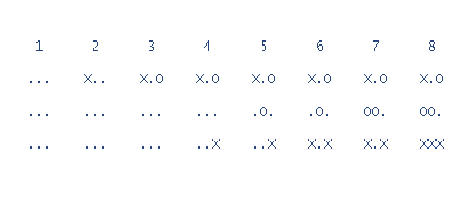
Your job is to read a grid and to determine whether or not it could possibly be part of a valid Tic Tac Toe game. That is, is there a series of plays that can yield this grid somewhere between the start and end of the game?
Input
The first line of input contains N, the number of test cases. 4N-1 lines follow, specifying N grid configurations separated by empty lines.
Output
For each case print "yes" or "no" on a line by itself, indicating whether or not the configuration could be part of a Tic Tac Toe game.
Example
Input:
2
X.O
OO.
XXX

O.X
XX.
OOO

Output:
yes
no
hide comments

|
Simes:
2023-07-19 11:58:48
@sayedreda.
|

|
sayedreda:
2023-07-18 21:51:53
My Idea is as simple as counting number of x and number of o and x has to be greater than o at most 1 (1 || 0) and it gives WA i don't know why?
|

|
ms2052001:
2022-07-10 20:09:23
I was insisting on getting this accepted without BFS and after 6 "Wrong answer" submissions, I managed to get it "Accepted" when I noticed that if (O) wins the game the number of points with (X) must equal the number of (O) points. |

|
sachin_08:
2022-01-09 20:51:57
Try possible layouts using BFS. |

|
mimi0007:
2021-05-19 19:54:45
I was stuck in these cases:
|

|
abhishek_r05:
2021-04-29 14:13:24
This can be solved without bfs , pretty easily. Just divide into some cases. |

|
fatahchan:
2020-12-18 01:41:31
i honestly dont understand whats wrong with my code, I already test many test cases and it still says my answer is wrong, can someone take a look at my code
|

|
saad1439:
2020-07-06 18:57:49
Read the last statement carefully!
|

|
tosnejan:
2020-02-20 18:12:30
This one caused me a lot of trouble.
|

|
tsunami_98:
2019-07-01 17:30:30
Great Problem ...thanks |
| Added by: | Camilo Andrés Varela León |
| Date: | 2006-12-14 |
| Time limit: | 1s |
| Source limit: | 50000B |
| Memory limit: | 1536MB |
| Cluster: | Cube (Intel G860) |
| Languages: | All except: ERL JS-RHINO NODEJS PERL6 VB.NET |
| Resource: | Waterloo local 2002.09.21 |
 RSS
RSS